Hannes Schumacher
🗓 SUNDAYS, weekly for 5 weeks, beginning July 6, 2025.
⏰ 11 AM-1 PM Eastern US Time. See time zone converter if you’re in a different location to make sure you get the time right.
🔗 A Zoom link will be provided on registration.
💰Four options (registration at bottom of this page.):
(i) $95 for non-members (become a member).
(ii) $80 for members.
(iii) Donation of your choice.
(iv) No cost solidarity. We are happy to make our offerings available to you even if you cannot afford to pay at this time. Before you select this option, we ask you to consider: (1) Whether you can make even a minimal donation. No amount is too small to help us offset our considerable costs; (2) Whether you are reasonably certain that you will attend the entire session(s). For a Solidarity ticket, please email us at we encourage you to email us requesting this option: inciteseminarsphila@gmail.com. Thank you.
COURSE DESCRIPTION
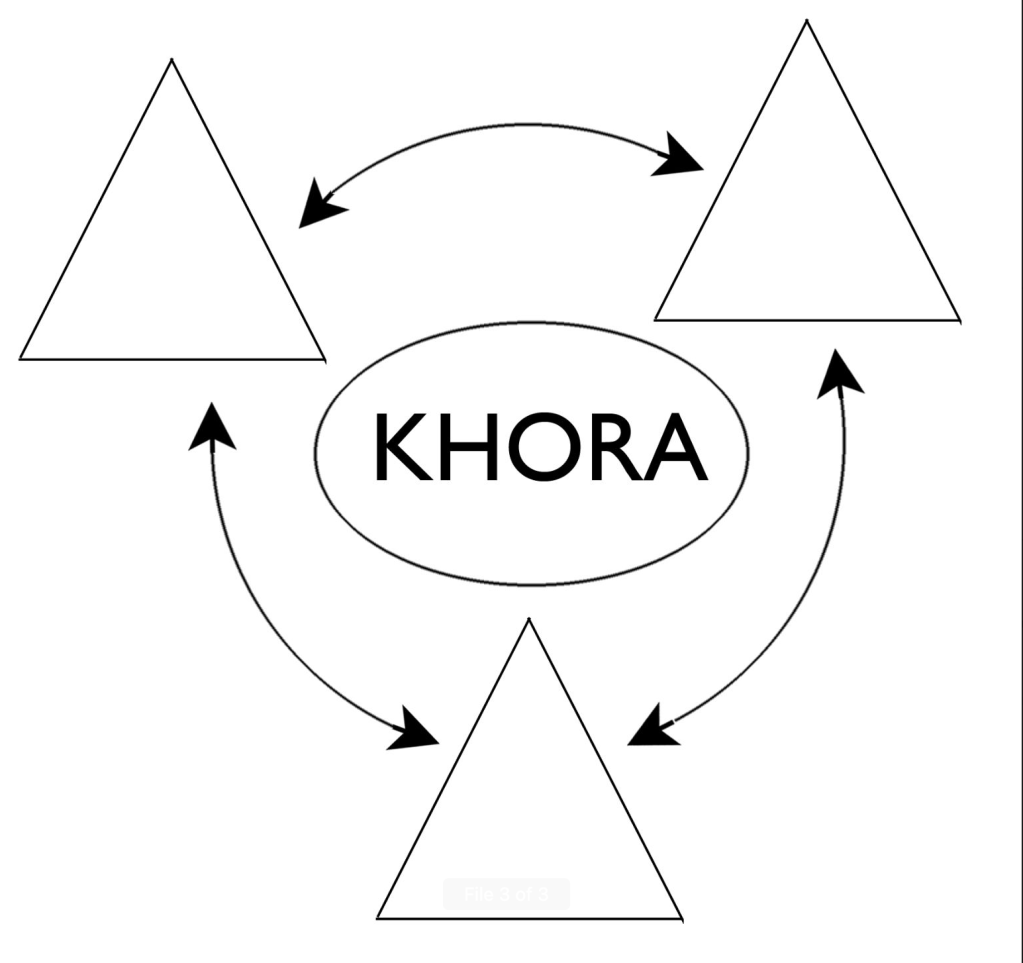
Plato’s Timaeus is one of the most influential texts of all times, perhaps the first to present a strictly philosophical account of the creation of the world. Since Ideas are eternal, creation implies a sort of “bastard reasoning” according to which a demiurge gives shape to chôra/khôra (χώρα), translated as “receptacle,” “matter,” or “place.”
In Plato’s dialogue, chôra is compared to a “mother” and presented as the “nurse of all becoming,” which has given rise to a feminist interpretation and critique (Irigaray, Kristeva). In Derrida’s essay “Khôra” (1993), it even goes beyond the gender binary, conflating the “third type” of Plato with a “third gender.” As John Caputo concludes: “khôra is not even a receptacle. Khôra has no meaning or essence, no identity to fall back upon. […] In short, khôra is tout autre [wholly other], very.”
In chôra we are, thus, to uncover a blind spot at the very center of Western discourse: the key to overturning Platonism is already hidden in the work of Plato himself. In contrast to a widespread opinion, Plato not only transcends Aristotle’s hylomorphism by pointing at Ideas beyond matter (the so-called universals); he also subscends it, by pointing at the stuff preceding any form (chôra). Put in contemporary terms, Plato’s chôra (and that of Derrida) not only goes beyond—or rather down below—post-Kantian correlationism (Meillassoux); perhaps it even challenges the plane of immanence (Deleuze & Guattari) by subscending the dichotomy of atheism and religion.
Source: Jean Hite’s Blog
Facilitator: Having lived and studied all around the world, Hannes Schumacher works at the threshold between philosophy and art. He completed his MA in Berlin with a thesis on Hegel and Deleuze, and he has also published widely on Nishida, Nāgārjuna, chaos theory, global mysticism, and contemporary art. Hannes is the founder of the Berlin-based publisher Freigeist Verlag and co-founder of the grassroots art space Chaosmos ∞ in Athens, Greece. Recently, he has facilitated the following courses and groups at Incite Seminars: “Nishida Kitarō: The Logic of Place and the Religious Worldview”; “Who’s Afraid of Hegel: Introduction to G. W. F. Hegel’s Science of Logic”; “Chaos Research Group” (current); and “Reading After Finitude by Quentin Meillassoux”; “Deleuze & Guattari: What is Philosophy?“
Course Materials
In this seminar, we’ll delve into Plato’s original formulations in the Timaeus and then discuss one groundbreaking interpretation: that of Derrida. PDFs of both texts will be provided on registration.
Sessions
1) Introduction: Plato’s chôra in contemporary thought
2) Plato’s chôra in the Timaeus (48e – 53b)
3) Derrida’s “Khôra” 0 – I: Mise en abyme
4) Derrida’s “Khôra” II – IV: triton genos
5) Richard Kearney: “God or Khora?”
REGISTRATION
Non-Member (become a member of Incite Seminars)

Members

Donation

 Incite Seminars