Thirty-Nine Theses on Absurdist Mysticism
Hannes Schumacher
Part I: argumentations
- If we are to conceptualize the notions of atheism and disbelief on a global scale, the apparent dichotomy of atheism and religion seems wholly obsolete.
- While heterodox traditions such as Buddhism and Daoism may be claimed as atheist religions, European atheism is not radical enough as to truly affirm the death of God: the name of God is merely replaced by a whole series of new names such as Reason and Morality, Equality and Justice.
- At the same time, even orthodox religions have their mystical traditions, which—paradoxically—bear great similarities with the most radical forms of atheism.
- We have to clearly separate these notions and push them to their extremes, as to establish a more profound idea of (un)belief that is able to explain the dynamic entanglement of atheism and religion.
- Following the most radical atheists such as Nietzsche, Stirner, Cioran, so-called ‘atheism’ in mainstream culture and society is only a perpetuation of Christian ideals in the guise of disbelief. From the celebration of an abstract ‘humanity’ in Feuerbach and the ideology of ‘equality’ in Marxism to the proclamation of ‘human rights’ in the agenda of the United Nations, they identify a hidden metaphysics that is only atheist if seen from a superficial stance.
- As to truly understand the death of God, it is not enough only to wipe out the obsolete existence of God: the death of God is an event that manifests itself on all levels of culture and society, such as the absolute lack of a true essence, reason, morality, and meaning of life.
- This radically absurdist worldview is famously expressed in the literature of Beckett and Camus; but interestingly, it may be found as well in the skeptical dialectics of Nāgārjuna, the founder of Mahāyāna Buddhism.
- Mystical traditions such as the Kabbalah in Judaism, Sufism in Islam, etc., differentiate between the official meanings of their sacred scriptures and a mystical meaning; Meister Eckhardt, for example, differentiates between a personal, transcendent God, and an impersonal Godhead that is ‘a silent desert’.
- In the actual traditions, these two truths (conventional and mystical) are mostly blurred: we thus have to clearly separate between these two as to develop a precise notion of mysticism.
- Such separation goes in line with a negative theology that dialectically negates all worldly features of the absolute: we now see that this procedure is not very different to the skepticism of radical atheism.
- This way, absurdism may be understood as a branch of global mysticism that undermines both theist and atheist orthodoxy. The result of this radical skepticism, however, is not nothingness but a creative chaos: absurdism, in this sense, is not a nihilism but a radical affirmation of the absurd and mystical.
- Think: God is even greater if he does not exist, if he is not himself a being. The true difference doesn’t lie between atheism and religion but between orthodoxy and mysticism.
- The absurd is the mystical, the mystical is the absurd. Such is the sublime strangeness of God.
Part II: provocations
- The prophets of all world religions are possessed by God, who often takes the form of a demonic angel or an angelic demon (jinn or genius). Put this way, the Quran indeed was not written by Muhammad but by God who used Muhammad as a medium.
- It is, therefore, structurally irrelevant whether the prophet is a common human being, the daughter or the son of God, or his/her incarnation.
- ‘Unity’ with God consists in the temporary annihilation of the personal self, the Sufi concept of fanāʾ. Al-Hallaj’s identification with God—“I am the truth”—appears as heresy only for those who still believe in heresy.
- Revelation occurs in the desert, which is defined by its lack of points of differentiation: deserts of ice and deserts of sand, deserts of the sea and deserts of outer space. According to Sartre “nature is mute”; however, if one closely listens to the silence, inarticulate sounds start to appear that slowly grow louder as to culminate in nature’s orchestra.
- The great difficulty lies in the ‘translation’ of this silence or indefinite noise into articulate words. When Moses received the Ten Commandments on Mount Sinai, all he could hear was the indefinite throat sound ʾa of the Hebrew ʾanokhi; all else is human interpretation. Such is the beginning of orthodoxy.
- Yet without orthodoxy, the word of God could not be taught at all. Orthodoxy provides a set of thumb-rules, which however should not be taken all too seriously. Religion in its core has nothing to do with morality and laws. God is love and chaos.
- The meaning of life is an objection to life. Put this way, absurdism is utter affirmation. This is why the most important element in Kafka, Beckett, Cioran is in fact not despair but humor: a divine laughter which frees ourselves and should be taken seriously.
- Why are we here? Why do we exist? Why is there something rather than nothing? The answer to the most profound questions of philosophy is simple: for no reason. What at first sight appeared as a subjective skepticism, a libertine denial of the question, now finally reveals itself as the most profound solution to the problems of existence.
- In the words of Wittgenstein, “[t]here is indeed the inexpressible. This shows itself; it is the mystical.” — “Not how the world is, is the mystical, but that it is.”
- God does not exist but manifests himself in all beings. Like khôra in Plato, like basho in Nishida, God hides himself by showing himself: “The true mystery of the world is the visible, not the invisible.”
— Oscar Wilde
- There is, thus, no difference between God and Nature.
- Bread and wine are, thus, no symbols of the body and the blood of Christ but to be taken literally.
- God is this morning glory and this rising of the sun; God is this cigarette butt and this ashtray. Literally so.
- The sacred is indifferent to its own profanation. It may be polluted without losing its glance: there is neither good nor evil. But who can see what I see will be stunned by its beauty for a lifetime.
- As different peoples have a different word for ‘water,’ they have a different idea of God. This is so because God is like water himself and may be put in different forms and shapes.
- According to the Kabbalah, before the creation of the world, the Torah was composed of unconnected letters of the Hebrew alphabet (letter soup). All creation and the history of the world is this very soup of letters articulated in words and sentences. When the Messiah comes—and this is now—these letters are mixed up again.
- God is neither this nor that and at the same both at once. Nāgārjuna’s stance that all beings are essentially empty and interconnected only reveals the true essence of God as inessence. This is expressed in the image of Indra’s web: an infinite network of mirrored spheres of which each reflects the whole universe.
- While negative theology presupposes a true essence of God, absurdist mysticism even negates this essence as a human-all-too-human predication. God is the absolute inessence of all there is.
- Already in the 20th Century, mysticism had been understood as the proper starting point for uniting all religions of humanity. But this perennial approach is mostly limited to ideals of ‘wisdom’ and ‘spirituality’ without reflecting strictly philosophically.
- “There was neither non-existence nor existence then,” reads the first line of the Vedic hymn of creation known as Nāsadīya. If God does not exist and neither not-exist, if God is but a fluid stuff or chaos, all beliefs and disbeliefs may be unified without abandoning their differences. They reflect the different manifestations of God himself, whereas the nonmanifest God is utterly formless.
- The future religion of the world community will have to include all revelations of all traditions without insisting in the primacy or closure of any prophecies. The religion of Baháʼí has given great contributions to this, but still excludes the so-called polytheist, pantheist and atheist traditions by insisting in the mere existence of the one and only God: JHWE, Deus, Allah.
- Structurally speaking, there is no difference between Christian saints and Indian gods. God himself is neither one nor multiple but manifests himself as one and multiple.
- Most truly atheist philosophers are thoroughly religious in spirit. Why else would they invest a lifetime on a matter they are not interested in?
- Jesus made wine out of water. Probably, he mixed some magic mushrooms in, what explains the enthusiasm of his followers: ‘enthusiasm’—‘to have God within.’ But this does not spoil at all the sacredness of his endeavor: God is the magic mushroom—soma, as the early Vedas call it.
- It bears a certain difficulty to claim these thoughts as utterly religious. But if we are to establish a future religiosity, we cannot be silent concerning the phenomenon of disbelief which marks a central pole of belief itself. A future religion will have to include both, what I tried to point out in reference to global atheism. The (un)belief in God as love and chaos lies at the core of a resistance against the return of our fascist history.
- “Amor vincit omnia.” — Virgil
____________________
Author: Having lived and studied all around the world, Hannes Schumacher works at the threshold between philosophy and art. He completed his MA in Berlin with a thesis on Hegel and Deleuze, and he also published widely on Nishida, Nagarjuna, chaos theory, global mysticism, and contemporary art. Hannes is the founder of the Berlin-based publisher Freigeist Verlag and co-founder of the grassroots art space Chaosmos ∞ in Athens, Greece. Recently, he facilitated with Incite Seminars “Nishida Kitarō: The Logic of Place and the Religious Worldview” and “Who’s Afraid of Hegel: Introduction to G. W. F. Hegel’s Science of Logic” and currently leads the Chaos Research Group.
“Thirty-Nine Theses on Absurdist Mysticism” was first published in Otstoinik Journal #2, Moscow (2021).
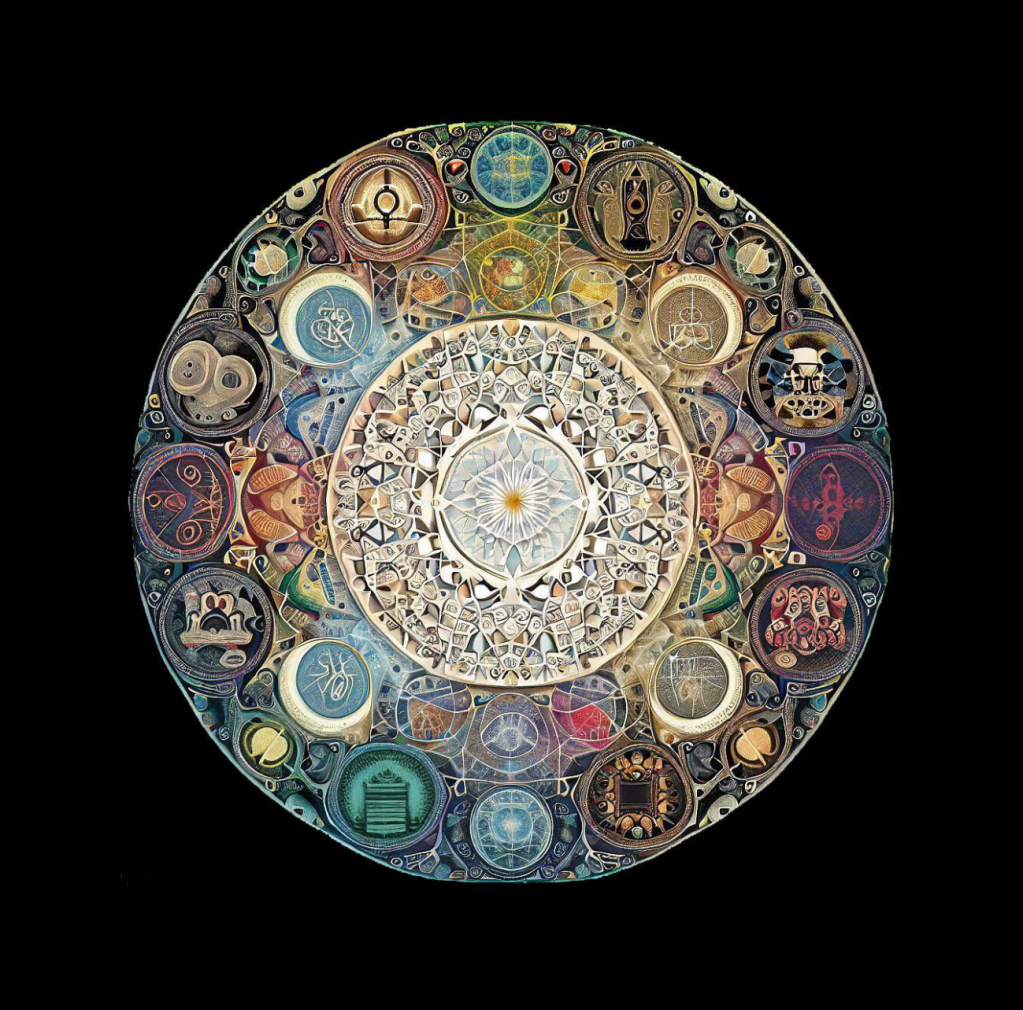
Image: AI-generated by author.

 Incite Seminars