The Vajra Master
(Inspired by Gendun Chopel)
Henry Blanke
Born in eastern Tibet in 1903, he was stripped from his
mother’s arms at a tender age and proclaimed an incarnate lama. He was placed into a cold, dank monastery under the tutelage of celibate old men. He sublimated his loneliness and rage into learning the rigorous Gelukpa scholastic curriculum as few had as well as mastering meditation and ritual. The young
monk rose rapidly through the clerical ranks, dispatching other monks in dialectical debate with a sharp clap of his hands to which he added a gestural flourish which the younger monks imitated. But his irreverent ideas and challenges to dogmatic orthodoxy proved too much for his superiors and eventually he was expelled from the monastery.
The monk set off trekking over snow-peaked mountains in search of a teacher. One day he gazed up from a trail and caught a glimpse of an old man living in a hut on a high peak. He made his way to the hermitage but did not knock on the door. If this was the Master he sought, he must prove himself worthy so he waited the night in the snow and in the morning was granted admission. The wizened man asked what he sought and he answered that he desired insight and compassion. This must have been satisfactory as he was offered salted yak-buttered tea and invited to stay.
He learned that the man was a learned Rinpoche who 30 years ago had turned down an appointment as Abbot of his monastery in order to live the rest of his life in contemplative seclusion. The monk noted that inside this austere abode the small window showed only radiant white and brilliant azure blue and wondered about the mind of a man whose eyes met
little but this for all those years. One night after the regular routine of chanting, ritual offerings and yogic meditation was complete, the Master explained that the bureaucracy and hierarchy of monastic life was not suited to him. Here he was free to create an inner universe of multi-colored deities, some wrathful, others benign, playing in divine copulation.
After two years the monk was initiated into esoteric Tantric practices intended to transform the adept’s body into a microcosm of the cosmic union of all polarities. The Master closely guided his yogic development but one day told him this: “You indeed have a rare spiritual gift. But your temperament suits you better for the left-hand path. This I cannot teach you so must go and find a Master who can initiate you into the highest Yoga Tantra.” The next day he bade farewell to his beloved teacher and set off for Bharat.
After an arduous journey the monk arrived in Sikkim and inhaled the profusion of Hindu monastic orders and the heady atmosphere of Tantrism. He made contact with the Indian scholar S.B. Battacharya, whom he had befriended in Tibet, and who agreed to accompany him to Assam and West Bengal which were not only hotbeds of Tantric culture, but home to
the burgeoning Indian Communist movement. In Bengal he heard a lecture on Marxism by the renowned Tantric and scholar Debiprasad Chattopadyaya which was revelatory for him. As he noted in his travel journal, “why should not everyone, commoners, lay people and the poor, not be allowed
to flourish and enjoy the fruits of the earth?” The monk read the first volume of Marx’s Capital with interest, but some difficulty since he had no knowledge of economics. But it was the lyrical humanism of the 1884 Manuscripts which fired his
imagination and he found Marx’s theories of alienation and reification similar to the Madhyamaka philosophy which deconstructs reified concepts. And he encountered the living tradition of Hindu Tantrism and compared it with his own Vajrayana practices.
At some point the monk relinquished his vows of celibacy and, for the first time, experienced the joys of sexual discovery and experimentation. He took up with a courtesan named Lakshmi and their erotic explorations together formed the basis of what became his most famous and, to many, his most scandalous work. The Book of Love and Passion contained explicit descriptions of outre` sexual positions and practices such as reverse female superior, simultaneous oral stimulation and oral
anilingus. He wrote of licking honey off his lover’s body and likened her vagina to a juicy ripe mango. “Performing their favorite postures of passion, they become drunk with desire and deny themselves nothing. While making love they do everything.” And, in keeping with his new Marxian sensibility, he stressed that these pleasures should not be limited to the decadent aristocracy, but be freely enjoyed by the masses. “Most people, those of common birth and rank are denied the full banquet of erotic delights. What a crime! We must wrest the ways of love from those bloated with wealth and power.” While intended for lay readers the book recommends Tantric techniques for delaying ejaculation. The monk’s sex manual was only the second ever written by a Tibetan (he pointed out that the first, by the great 19th century polymath Mipam, was based on earlier texts while his came from experience). Lakshmi introduced him to the Kolkata bohemian demimonde where he
fit in well and relished in the all-night discussions of avant-garde art and poetry fueled by cannabis and copious amounts of Johnnie Walker whiskey. He met artists, poets and musicians from around the world and reported in his journals of partaking in orgies involving prostitutes, homosexuals, bisexuals and
those of ambiguous gender.
Now going by his family name Dawa Gyatso, the former monk eventually set out to walk the length of India with little money, an experience he described as one of awe and discovery. He wrote of seeing young village girls rubbing clarified butter on large phalluses, being fed simple but tasty vegetarian food and
was touched by the hospitality of the locals. But he also went through periods of self-doubt and poor health. After eight months Dawa reached Kerala where he stayed with an elderly former sanyasini whom Battacharya had told him about. She provided rest, ample food and, when she learned of his interest
in Tanrism, a piece of information which proved invaluable. “If you are serious about pursuing the left-hand path, go at night the charnel ground just east of here. There you will find a circle of Shakta devotees. You will know who the guru is.” The first night he saw no one, but on the second he found them. He watched from a distance as they ritually consumed goat, drank
wine and smoked ganga. Then before daybreak they paired off and he was witness to the practice of sexual yoga. The men coupled with their consorts and intoned mantras which he recognized from Sanskrit texts brought to Tibet. And then he saw her. She seemed to be in her late thirties with lustrous waist length black hair and an ample bosom. She wore a tiger skin garment and a necklace of skulls. When the ceremony concluded she was looking at him with blazing blue-green eyes and motioned to follow her. When they reached her quarters she introduced herself as Siddhimata and invited him in. At first
he was intimidated by her beauty and the aura of her presence. But she was informal and warm. As they drank tea she asked why he, a Tibetan Buddhist had come all the way to Bharat. He told her of the monastery, his erstwhile ascetic master and his advice to find the source of Tantrism and a teacher. She
listened closely, but changed the subject to an abstruse point of Sankhya philosophy. As he left, she told him that she would be giving darshan the next morning and that he should come.
When Dawa returned there was a long line of people waiting to receive Siddhimata’s blessing. He waited patiently for hours and when the others were gone she smiled and invited him into her hut, offering him a variety of sweets and fruit. “So you are curious about our rituals as I am about yours. But if it is initiation you seek … well, that is a rather long and difficult procedure requiring considerable discipline and devotion. And it is not offered to non-Hindus. But I see that you are a most unusual monk and I have never been one for orthodoxy. If you like, you can come here every afternoon and we can discuss these matters. He readily agreed and thus began a routine of visiting Siddhimata every day to discuss philosophy, ritual and
scripture as well as personal things. He learned that she was born to an Assamese Brahmin family in Guwahati and at 16 was betrothed to a caring, but rather boring man fifteen years her senior. The night before her wedding she disappeared and lived alone in the forest for almost two years. During this time she
had several profound visionary experiences which converted her to Shakta Tantrism. He felt that she had omitted some important details of her story, but did not attempt to satisfy his curiosity.
After some months Siddhimata gradually began introducing him to certain rituals and meditations which ignited a strange inner flame in him. Then one day after darshan, she told him to return in two hours. When he did the door to her abode was ajar. Dawa peered in and saw lit candles and smelled sandalwood incense. He entered and saw that she was different. Gone was the woman he had come to know, replaced
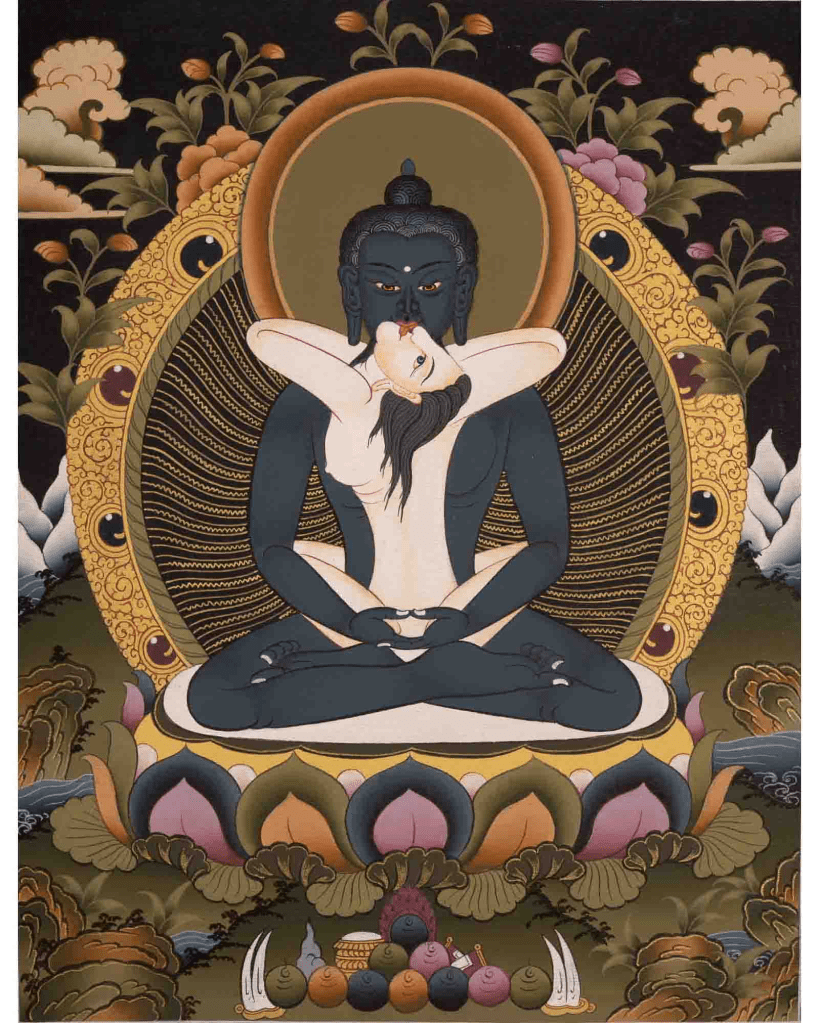
by an impersonal embodiment of something very old and sacred. Siddhamata beckoned him to sit cross legged facing her and, before he knew it, she was on his lap. Her scent of musk and cassia blended with the incense and made him lightheaded. He matched the slow, deep rhythms of her breathing and visualized her as a fiercely seductive deity. “Om Aim Hrim Klim Chamundaye Vichche,” she chanted and he found himself intoning the mystical syllables with her. His penis grew erect which embarrassed him momentarily, but suddenly he was inside her. He felt electric currents flowing through his body and as he gazed deeply into her eyes as they became jeweled daggers of compassionate energy. Dawa employed the techniques he knew to control seminal emission and their embrace lasted a very long time. He was able to visualize the channels, winds and drops of the subtle yogic body which he had learned from her and his Tibetan guru and soon the coiled serpent in his genital region rose. As the energy ascended through his chakras, he experienced waves of intense bliss.
Finally, she whispered in his ear and he allowed himself to ejaculate. But this was unlike any orgasm he had experienced.
The combination of stilling his breathing, mind and ejaculatory impulse triggered the most powerful ecstasy Dawa had ever experienced. He became Shiva and Siddhimata was Shakti. Their union replicated in microcosm the cosmic union of all
polarities in divine play. For him the culminating peak was a vision of a web of gossamer threads. At the intersection of each thread was a crystalline jewel containing tiny Siva/Shakti images. Each jewel contained the reflection of all the other jewels which in turn reflected those around it and so on infinitely. Finally, Dawa and Siddhimata fell into a deep sleep in
each other’s arms. During the night he dreamed of a dancing dakini beckoning him to the land of snow and mountains. He knew he must return to Tibet and share his experiences in India and the wisdom he had gained. When he awoke, she was looking at him with great tenderness and compassion. Dawa began to speak, but she silenced him. “I understand that you
must go. You could stay here with me and be venerated as a powerful yogi. But you have a tender heart. You wish to share what you have learned to benefit others even though your future in your homeland is uncertain.” He was a bit puzzled by
what she meant by this last, but forgot it as they enjoyed a breakfast of dosa, iddli, sambar and rich coffee.
Dawa spent the next week planning his return to Tibet and gathering supplies. On the day of his departure he presented Siddhimata with a small amulet given to him by his father and he gifted him with a sanyassin’s ochre robe. Their parting was wordless but charged with meaning. As he turned to look at her one last time, she had taken on a shimmering almost diaphanous appearance which he took a sign of the transitory nature of the world. The return trip was long but uneventful and Dawa arrived in Lhasa in the spring of 1946 to a hero’s welcome. He had spent nine years in India. However, some time the following year, he was arrested and imprisoned on suspicion of being a spy for the Chinese. News of his involvement with the Indian Communist Party had reached Lhasa. This was compounded by his attendance at meetings of a reformist movement which was highly critical of the
government. Dawa was beaten, but the guards were lax and friends smuggled in books, cigarettes and the whiskey he had grown so fond of.
Dawa was released from prison in 1950 an alcoholic and broken man. But he mustered the strength to write a book on the philosophy of the great Indian sage Nagarjuna. His political history of Tibet was left unfinished as his health declined. He spent his last year with a simple and kind lover and lived just long enough to see Chinese troops marching through the streets of Lhasa, his dream of a modern, progressive Tibet forever dashed.
Dawa Gyatso was a Tantric yogi, a philosopher-poet, a linguist, sexologist and a bohemian cosmopolite. And he was Tibet’s first visionary modernist.
____________________
Henry Blanke is a Soto Zen Buddhist and long-time member of the Democratic Socialists of America. He is an essayist and poet, a bohemian flaneur and is currently working as a substance abuse counselor in Brooklyn, New York.
____________________
Image: Traditional Tibetan Buddhist thangka showing Samantabhadra and Samantabhadri in the yab yum (ཡབ་ཡུམ།: “father-mother”) position unifying compassion and wisdom.


 Incite Seminars