
In Lovely Blue
Friedrich Hölderlin (1770-1843)
Translated by Glenn Wallis
In lovely blue the steeple blooms with its metal roof.
Around the roof swirls the swallows’ cry,
surrounded by most touching blue.
The sun rises high above and tints the roof tin.
But in the wind beyond,
silently, a weathercock crows.
When someone comes forth
from the stairs of the belfry, it is a still life.
And though the form is so utterly strange,
it becomes the figure of a human being.
The windows out of which the bells resound
are as gates to beauty.
Because gates still take after nature
they resemble forest trees.
Purity, too, is beauty.
From within, out of diverse things,
a grave spirit emerges.
So simple, these images, so holy,
that one often fears to describe them.
But the heavenly ones, always good,
possess virtue and joy
even more than do the wealthy.
Humans may follow suit.
Might a person, when life is full of trouble,
look up and say:
I, too, want to be like this?
Yes. As long as friendliness and purity
dwell in our hearts,
we may measure ourselves not unfavorably
with the divine.
Is God unknown? Is he manifest as the sky?
This I tend to believe.
It is the measure of the human.
Deserving, yet poetically, we dwell on this earth.
The shadow of night with its stars,
if I may say so, is no purer
than we who exist in the image of the divine.
Is there measure on earth?
There is none.
For the creator’s worlds can never contain
the clap of thunder.
Because it blooms under the sun,
a flower, too, is beautiful.
In life, the eye often finds creatures to call more beautiful still than flowers.
Oh! I know this well!
For to bleed in body and heart and cease to be whole— does this please God?
The soul, I believe, must remain pure,
or else the eagle will wing its way
to the almighty with songs of praise
and the voice of so many birds.
It is substance and it is form.
Beautiful little brook,
so touching you seem as you roll so clear,
like the eye of God, through the Milky Way.
I know you well. But tears stream from my eyes.
A clear life I see in the forms of creation
that bloom around me
because I do not compare them unreasonably
with the lonely pigeons in the churchyard.
People’s laughter seems to grieve me —
after all, I have a heart.
Would I like to be a comet?
I believe so.
For they have the quickness of birds,
they blossom in fire,
and in their purity is as children’s.
To wish for more is beyond
the measure of human nature.
The clarity of virtue also deserves
praise from the grave spirit
that blows between the garden’s three pillars.
A beautiful virgin must garland her head with myrtle,
for to do so is simply her nature and her sensibility.
But myrtle trees are found in Greece.
When a person looks into a mirror and sees his image
as if painted, that is like the Manes.
The human form has eyes, but the moon has light.
Perhaps King Oedipus had an eye too many.
This man’s suffering seems indescribable, unspeakable, inexpressible.
When the drama presents it so, so it is.
But how is it with me?
Am I thinking now of your suffering?
Like brooks, the end of Something
as vast as Asia is carrying me toward it.
Oedipus, of course, suffered like this, too;
and certainly for the same reason.
Did Hercules suffer as well? Of course.
Did not the Dioscuri, too, in their friendship bear pain?
As Hercules fought with God — that is suffering.
And immortality in envy of this life
— to divide these two —
that, too, is suffering.
But it is also suffering
when a person is covered with freckles —
to be completely covered with freckles!
The beautiful sun does that,
for it draws out everything.
The path seduces the young
with the charm of its rays, like roses.
Oedipus’s suffering is like a poor man
wailing that he is deprived.
Son Laios, poor stranger in Greece.
Life is death, and death is also a life.
DISCUSSION
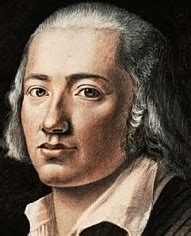
Some commentators view Hölderlin as naive and sentimental. He himself had this to say about that:
The epic poem, naive in appearance, is heroic in its significance. It is the metaphor of great aspirations.
Georg Lukács, certainly no sentimentalist, had this to say about the poet:
He is neither an insipid optimist nor a despairing irrationalist pessimist. His style neither sinks into an academic classicistic objectivism nor into an amorphous, impressionist subjectivism; his poetry is neither dryly and didactically intellectual nor atmospheric and void of thought. (Georg Lukács, “Hölderlin’s Hyperion,” 1934.)
One of the reasons I turn to Hölderlin when I find “no” on my lips, is that he, too, yearned daily and deeply for a more humane, satisfying world. He modeled this yearned-for world on romantic notions of ancient Greece. But he knew better than to be snookered by the longings born of his utopian fantasies.
Hölderlin’s lyricism is a lyricism of ideas. Its point of departure is formed by the inner contradiction of the bourgeois revolution raised to the level of a Weltanschauung (and mystified, of course, in an idealistic manner). Both aspects of the contradiction exist in this poetry of ideas: the Jacobin Hellenic ideal and the ignoble bourgeois reality. The imperishable greatness of Hölderlin lies in his superb stylistic mastery of the insoluble contradiction which was basic to his social existence…His historical and personal tragedy, the fact that the heroic “illusions” of the bourgeoisie could no longer be the banner for real revolutionary heroism, but only that of the yearning for such heroism, constitutes precisely the stylistic presupposition of this (relative) success. (Ibid.)
The point was the very yearning itself: vivifying, inspiring, exhilarating and exhausting, depressing, crushing.
I have heard people say that they don’t have the patience for Hölderlin because he is too demanding, too cryptic. He certainly demands your full attention. For example, his syntax is purposefully closer to Ancient Greek than it is to Modern German. This makes him very difficult to read, much less to translate.
The young, aspiring Romantic poet Wilhelm Waiblinger (1804-1830) left a moving description of Hölderlin (see below). Waiblinger was a theology student in Tübingen, and, between 1822-1826 when the poet was already mentally ill, often visited Hölderlin. On one of his visits, Waiblinger claims to have seen a sheet of paper with “In lieblicher Bläue” scribbled on it lying on a table in Hölderlin’s solitary tower. He then transcribed it into his novel, Phaëthon. For various reasons, some scholars believe that the poem is an invention of Waiblinger. (See, for instance, Emmon Bach, “In Lieblicher Bläue”: Hölderlin or Waiblinger?” The Germanic Review: Literature, Culture, Theory Volume 36, 1961, Issue 1: 27-34.) If that is true, good on Waiblinger! But having read a shit ton of Hölderlin over the last three decades, all I can add to the debate is that it sure sounds like crazy Fritz himself!
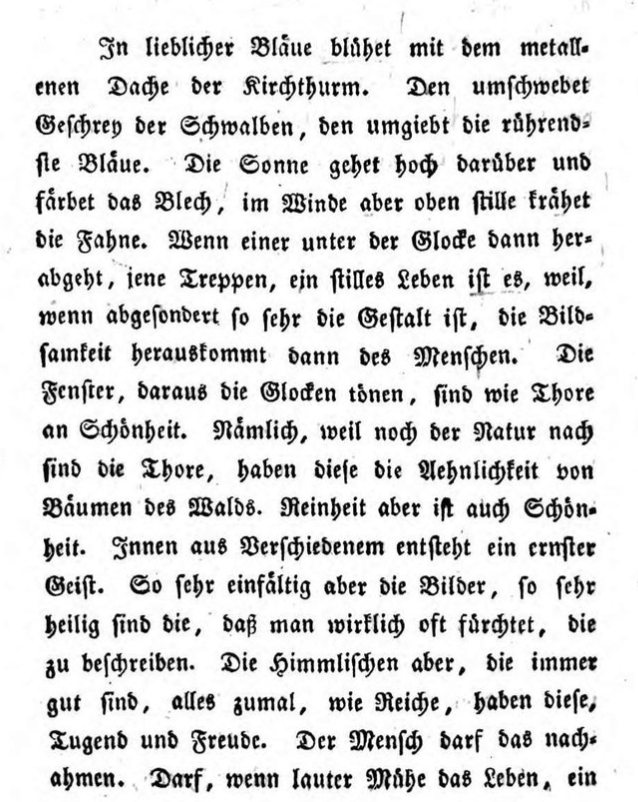
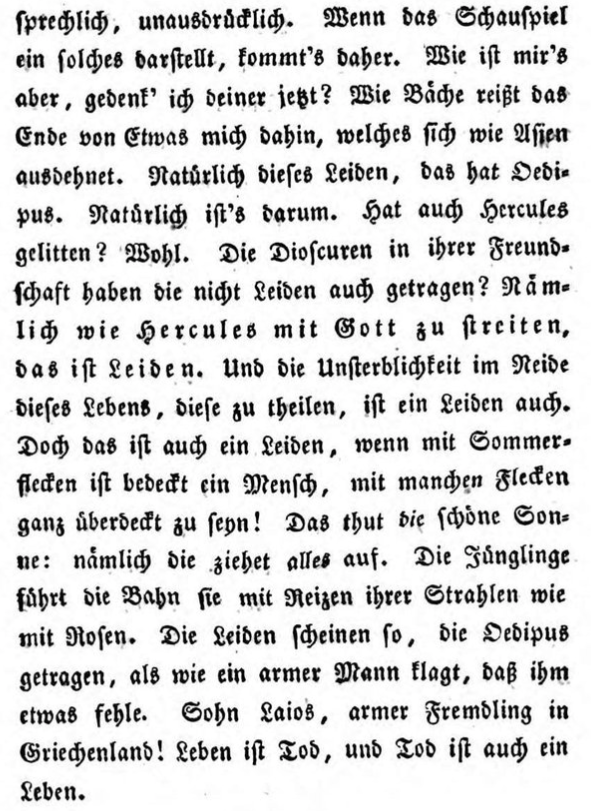
My translation is based on Sattler’s Frankfurter Hölderlin Ausgabe, vol. 8, Σ285. Here’s the German text as it appears in Waiblinger, F. W. Waiblinger, Phaëthon, Zwey Theile (Stuttgart: Verlag von Friedrich Franckh, 1823), pp. 153-156. Although he says that, “In the original, it is divided, like Pindar’s verses,” Waiblinger presents the poem as prose. Here goes.
___________________________
Jn lieblicher Blaͤue bluͤhet mit dem metall-
enen Dache der Kirchthurm. Den umſchwebet
Geſchrey der Schwalben, den umgiebt die ruͤhrend-
ſte Blaͤue. Die Sonne gehet hoch daruͤber und
faͤrbet das Blech, im Winde aber oben ſtille kraͤhet
die Fahne. Wenn einer unter der Glocke dann her-
abgeht, jene Treppen, ein ſtilles Leben iſt es, weil,
wenn abgeſondert ſo ſehr die Geſtalt iſt, die Bild-
ſamkeit herauskommt dann des Menſchen. Die
Fenſter, daraus die Glocken toͤnen, ſind wie Thore
an Schoͤnheit. Naͤmlich, weil noch der Natur nach
ſind die Thore, haben dieſe die Aehnlichkeit von
Baͤumen des Walds. Reinheit aber iſt auch Schoͤn-
heit. Jnnen aus Verſchiedenem entſteht ein ernſter
Geiſt. So ſehr einfaͤltig aber die Bilder, ſo ſehr
heilig ſind die, daß man wirklich oft fuͤrchtet, die
zu beſchreiben. Die Himmliſchen aber, die immer
gut ſind, alles zumal, wie Reiche, haben dieſe,
Tugend und Freude. Der Menſch darf das nach-
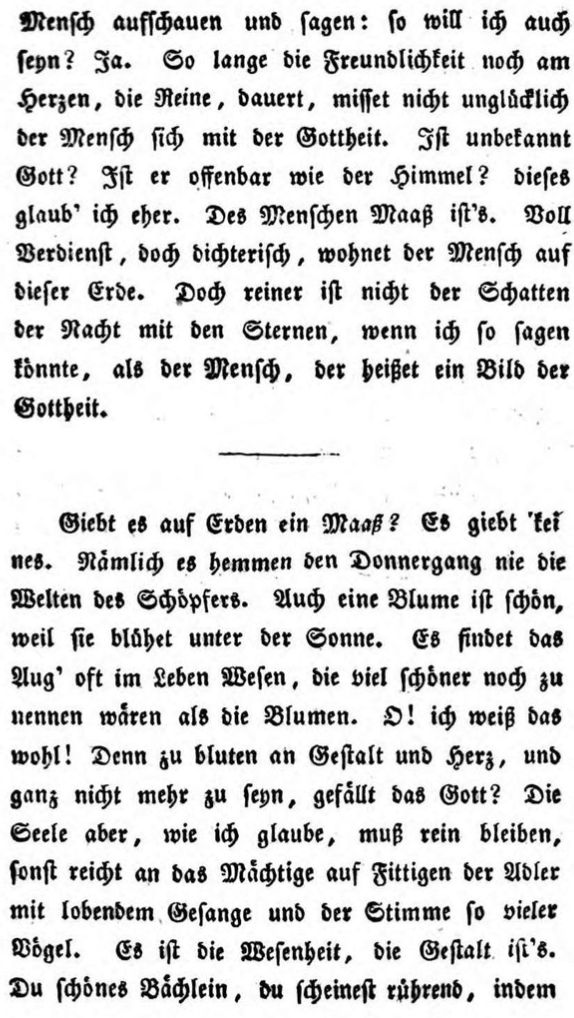
ahmen. Darf, wenn lauter Muͤhe das Leben, ein Menſch aufſchauen und ſagen: ſo will ich auch
ſeyn? Ja. So lange die Freundlichkeit noch am
Herzen, die Reine, dauert, miſſet nicht ungluͤcklich
der Menſch ſich mit der Gottheit. Jſt unbekannt
Gott? Jſt er offenbar wie der Himmel? dieſes
glaub’ ich eher. Des Menſchen Maaß iſt’s. Voll
Verdienſt, doch dichteriſch, wohnet der Menſch auf
dieſer Erde. Doch reiner iſt nicht der Schatten
der Nacht mit den Sternen, wenn ich ſo ſagen
koͤnnte, als der Menſch, der heißet ein Bild der
Gottheit.
Giebt es auf Erden ein Maaß? Es giebt ’keines. Naͤmlich es hemmen den Donnergang nie die
Welten des Schoͤpfers. Auch eine Blume iſt ſchoͤn,
weil ſie bluͤhet unter der Sonne. Es findet das
Aug’ oft im Leben Weſen, die viel ſchoͤner noch zu
nennen waͤren als die Blumen. O! ich weiß das
wohl! Denn zu bluten an Geſtalt und Herz, und
ganz nicht mehr zu ſeyn, gefaͤllt das Gott? Die
Seele aber, wie ich glaube, muß rein bleiben,
ſonſt reicht an das Maͤchtige auf Fittigen der Adler
mit lobendem Geſange und der Stimme ſo vieler
Voͤgel. Es iſt die Weſenheit, die Geſtalt iſt’s.
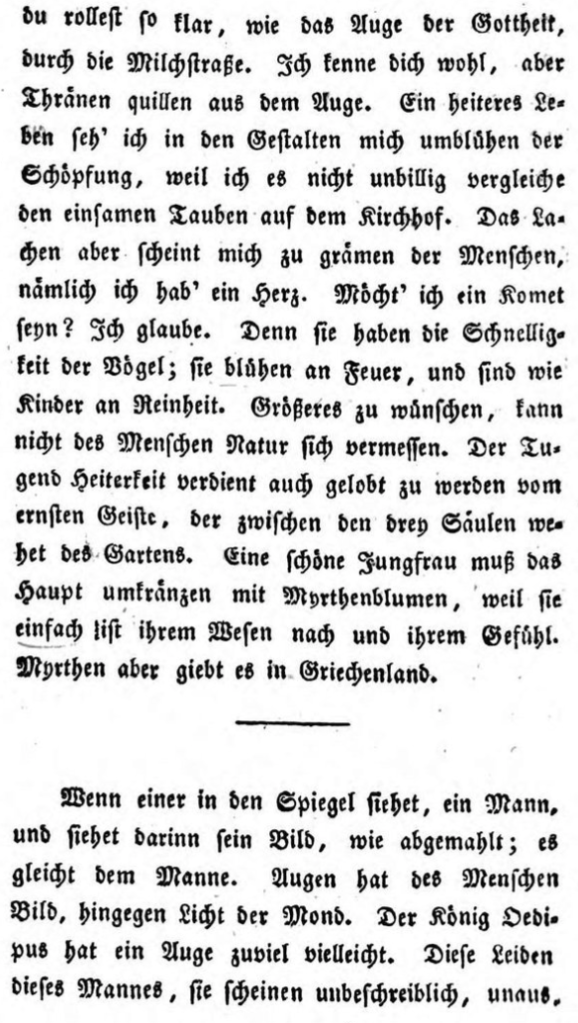
Du ſchoͤnes Baͤchlein, du ſcheineſt ruͤhrend, indem du rolleſt ſo klar, wie das Auge der Gottheit,
durch die Milchſtraße. Jch kenne dich wohl, aber
Thraͤnen quillen aus dem Auge. Ein heiteres Le-
ben ſeh’ ich in den Geſtalten mich umbluͤhen der
Schoͤpfung, weil ich es nicht unbillig vergleiche
den einſamen Tauben auf dem Kirchhof. Das La-
chen aber ſcheint mich zu graͤmen der Menſchen,
naͤmlich ich hab’ ein Herz. Moͤcht’ ich ein Komet
ſeyn? Jch glaube. Denn ſie haben die Schnellig-
keit der Voͤgel; ſie bluͤhen an Feuer, und ſind wie
Kinder an Reinheit. Groͤßeres zu wuͤnſchen, kann
nicht des Menſchen Natur ſich vermeſſen. Der Tu-
gend Heiterkeit verdient auch gelobt zu werden vom
ernſten Geiſte, der zwiſchen den drey Saͤulen we-
het des Gartens. Eine ſchoͤne Jungfrau muß das
Haupt umkraͤnzen mit Myrthenblumen, weil ſie
einfach |iſt ihrem Weſen nach und ihrem Gefuͤhl.
Myrthen aber giebt es in Griechenland.
Wenn einer in den Spiegel ſiehet, ein Mann,
und ſiehet darinn ſein Bild, wie abgemahlt; es
gleicht dem Manne. Augen hat des Menſchen
Bild, hingegen Licht der Mond. Der Koͤnig Oedi-
pus hat ein Auge zuviel vielleicht. Dieſe Leiden
dieſes Mannes, ſie ſcheinen unbeſchreiblich, unaus,
ſprechlich, unausdruͤcklich. Wenn das Schauſpiel
ein ſolches darſtellt, kommt’s daher. Wie iſt mir’s
aber, gedenk’ ich deiner jetzt? Wie Baͤche reißt das
Ende von Etwas mich dahin, welches ſich wie Aſien
ausdehnet. Natuͤrlich dieſes Leiden, das hat Oedi-
pus. Natuͤrlich iſt’s darum. Hat auch Hercules
gelitten? Wohl. Die Dioſcuren in ihrer Freund-
ſchaft haben die nicht Leiden auch getragen? Naͤm-
lich wie Hercules mit Gott zu ſtreiten,
das iſt Leiden. Und die Unſterblichkeit im Neide
dieſes Lebens, dieſe zu theilen, iſt ein Leiden auch.
Doch das iſt auch ein Leiden, wenn mit Sommer-
flecken iſt bedeckt ein Menſch, mit manchen Flecken
ganz uͤberdeckt zu ſeyn! Das thut die ſchoͤne Son-
ne: naͤmlich die ziehet alles auf. Die Juͤnglinge
fuͤhrt die Bahn ſie mit Reizen ihrer Strahlen wie
mit Roſen. Die Leiden ſcheinen ſo, die Oedipus
getragen, als wie ein armer Mann klagt, daß ihm
etwas fehle. Sohn Laios, armer Fremdling in
Griechenland! Leben iſt Tod, und Tod iſt auch ein
Leben.
Here is an excerpt from Waiblinger’s essay “Friedrich Hölderlin’s Life, Poetry and Madness” (1830), translated from the German by Scott J. Thompson:
Here is the original text of the poem from Waiblinger’s Phaëthon:

____________________
______________________
Image: “Bei Vollmond im Gutspark.”


 Incite Seminars